
Captain Steel highlights how regional TMT bar dealership networks support reliable steel availability, timely delivery and local construction needs.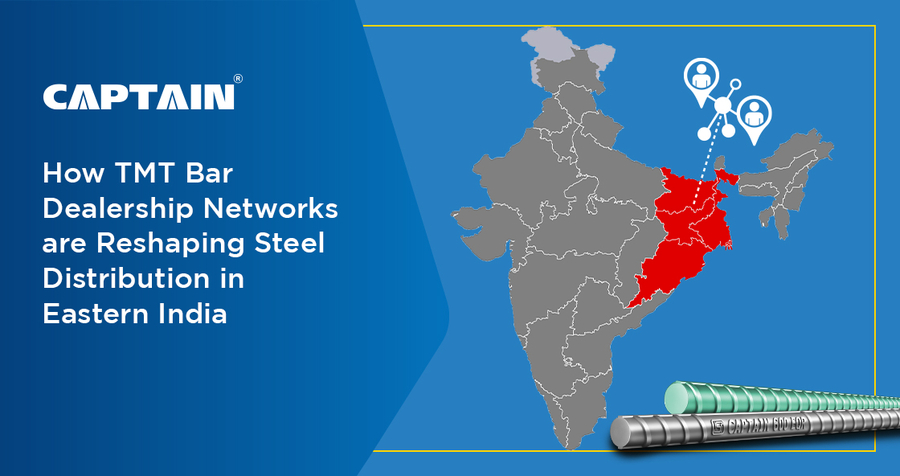
KOLKATA, INDIA, November 28, 2026 /24-7PressRelease/ -- In Eastern India's steel trade, the sale is won or lost long after the bar leaves the mill, at the dealer counter that decides whether the right grade reaches the right site on time. A builder names a grade, the dealer names a rate, a truck is arranged, and the whole thing looks routine. What that quick exchange hides is a distribution chain that has quietly become the real decider of whether reinforcement turns up on schedule, in the grade specified, at a price that holds. The dealer is no longer just a shopfront. The dealer is the system.
For years, the conversation about TMT steel fixated on the mill and the brand. How it was rolled, what grade it carried, whose name was stamped on it. Buyers are now asking a different set of questions, and most of them are about availability rather than metallurgy. Can the material arrive this week? Will the next consignment match the last? Is there someone nearby who stands behind the sale? Those questions are answered at the dealer level, not the factory gate.
Why the Dealer Layer Carries So Much Weight
Reinforcement is heavy, price-sensitive and bought in a hurry. A contractor who runs short mid-pour cannot wait days for stock to travel across two states. That single reality explains why a strong TMT bar dealership network matters as much to a manufacturer as the quality of its steel. The network is what turns a product sitting in a yard into a product available at the point and moment of demand.
Eastern India makes this especially clear. Construction activity here is spread unevenly across large cities, fast-growing district towns and rural blocks that build in seasonal bursts. A distribution model that works in Kolkata does not automatically serve a town three hours out. Reaching that spread takes dealers who understand their own catchment, carry the right mix of grades and sizes, and can replenish quickly when demand spikes. A manufacturer can roll excellent bars and still lose the sale if the material is not where the builder is standing.
Local Knowledge Is Part of the Product
The better dealers do more than hold stock. They know which contractors are active, which grades move in their area, how credit tends to work locally and when a building season will tighten supply. That knowledge shortens the distance between a manufacturer's output and a buyer's actual need. It is also why a TMT saria dealership is often the most trusted voice a small home builder hears, more than any advertisement. The person at the counter is the one who answers for the product after the sale.
This is where the manufacturer-dealer relationship stops being a formality. A dealership that is kept well supplied, given consistent quality and backed by a responsive manufacturer can promise continuity to its customers. One left guessing about the next consignment cannot. The strength of the arrangement shows up not in a good month but in a tight one, when stock is short and reliability is tested.
Where Captain Steel Fits the Pattern
Captain Steel India Limited offers a working example of this model. The company manufactures TMT bars in Eastern India and supplies through a dealer and distributor network that extends across several states, including its home market of West Bengal along with Bihar and Jharkhand. Its bars are produced to BIS specification under IS 1786, and the range covers standard grades alongside specialised lines such as the earthquake-resistant Captain 600 EQR and the corrosion-resistant Captain RustGuard. The point is not the size of any single network but the principle behind it: regional manufacturing works best when paired with distribution that actually reaches the markets it serves.
The direction of travel is clear enough. As buyers judge suppliers increasingly on availability, documentation and after-sale support rather than brand name alone, the dealer network becomes a competitive asset in its own right. A well-run TMT bar dealership is no longer a passive link in the chain. It is where a manufacturer's reputation is either kept or lost, one delivery at a time, and the companies that understand that will shape how steel moves across Eastern India in the years ahead.
Frequently Asked Questions
Q1: Why does the dealership network matter when the steel comes from the same mill?
Because availability, consistent supply and local support are decided at the dealer level. A builder needs the right grade and size when the work demands it, and a well-supplied dealer close to the site is what makes that possible, regardless of how good the mill is.
Q2: What should a buyer look for in a TMT dealer?
Whether the dealer stocks the grade and diameters the project needs, can supply consistently through a building season, provides proper documentation such as mill test certificates, and has a dependable link back to the manufacturer. Proximity helps, but reliability matters more.
Q3: Why is regional distribution especially important in Eastern India?
Construction demand is spread unevenly across cities, district towns and rural areas that build seasonally. A single distribution approach cannot serve all of them, so a network of dealers who know their local markets and can replenish quickly is essential to steady supply.
Q4: Does a larger dealer network automatically mean better service?
Not necessarily. Reach matters, but so does how well each dealer is supplied, how consistent the product quality is, and how responsive the manufacturer is. A well-managed network serves buyers better than a large but poorly supported one.
About Captain Steel India Ltd.
Captain Steel India Ltd. manufactures TMT reinforcement bars in Eastern India, with a footprint that reaches into Rajasthan, Uttar Pradesh, and Madhya Pradesh. Its bars are made to BIS specification under IS 1786, and the company has built its name on consistency: steel that meets grade batch after batch, not just on the day an inspector visits. The catalogue runs from standard grades to specialised lines, among them the earthquake-resistant Captain 600 EQR and the corrosion-resistant Captain RustGuard. A regional dealer network keeps that steel moving to residential, commercial, and infrastructure sites, with pricing and delivery terms kept transparent.
Read the original story here: https://www.24-7pressrelease.com/press-release/540875/how-tmt-bar-dealership-networks-are-reshaping-steel-distribution-in-eastern-india
Press Release Service and Press Release Distribution by 24-7 Press Release Newswire
How TMT Bar Dealership Networks Are Reshaping Steel Distribution in Eastern India
Nov 28, 2026
Looking for Local Media Coverage in the United States of America?
We have a place for all at the

What's Hot

General newsNov 25, 2026
Redd Thompson has 27 points as Mount St. Mary’s takes down Morgan State 75-74
General newsNov 25, 2026
Sebastien Emenalo scores 15 off the bench, Loyola (MD) knocks off Rider 71-54

SportsNov 25, 2026
Ravens waive LaJohntay Wester after 2 fumbled punts against Panthers
More News

General newsNov 24, 2026
Griffin scores 11 off the bench, Navy defeats Penn State-Berks 97-46
Press Releases
Best Black Light for Cat Urine: 365 nm Flashlights Compared ...
Traders Union Expands Website Analytics With New Forecasting...
Keystone Binder Lets Families Build an Emergency and Estate ...
GotRot Explains How Shade and Drainage Affect PVC and Compos...
Advertising Agency for Local Businesses: Get More Calls

Is Your Customer.
Publish news of your business, community or major event to get local media coverage and reach local audiences who really care.